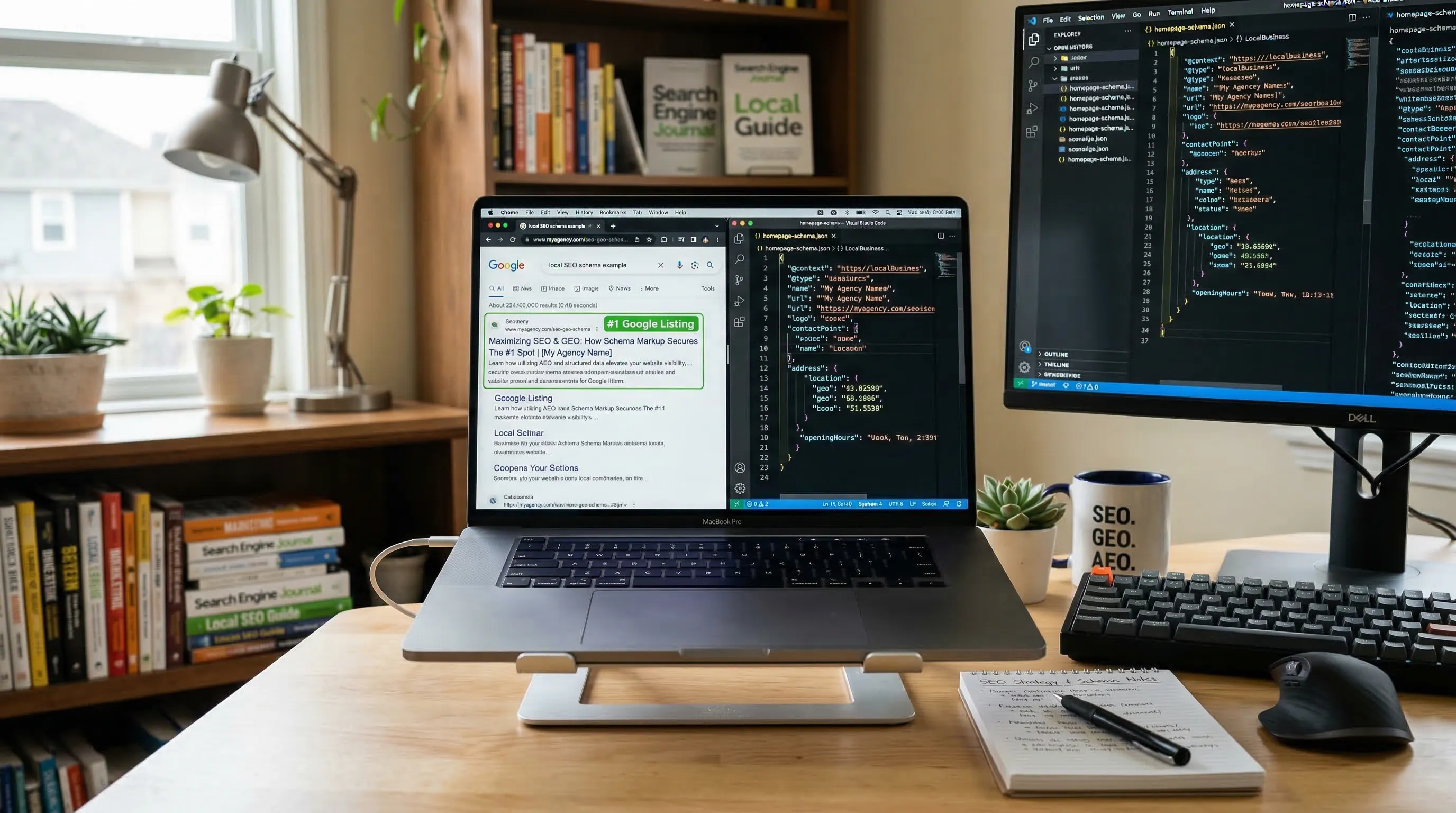
The Three Pillars of Modern Discoverability
In 2026, getting found online is no longer just about ranking on Google. Your business needs to be discoverable across three distinct channels: search engines (SEO), AI assistants (AEO), and location-based platforms (GEO). Each one relies on one critical foundation: metadata.
If your website lacks proper metadata, you are not just missing rankings. You are invisible to the systems that drive real customers to your door.
At GrowLocal Labs, we build every website with all three pillars baked in from day one. Here is why each matters and what you need to get right.
What Is Metadata and Why Should You Care?
Metadata is the structured information embedded in your website that tells search engines, AI models, and platforms what your content is about. It includes:
- Title tags — The headline that appears in search results and browser tabs
- Meta descriptions — The short summary beneath your title in search results
- Schema markup (JSON-LD) — Structured data that tells Google exactly what your business does, where it is located, what services you offer, and your FAQs
- Open Graph tags — Controls how your pages appear when shared on Facebook, LinkedIn, and other platforms
- Canonical tags — Prevents duplicate content issues by telling Google which version of a page is the original
- Alt text on images — Describes images for accessibility and gives search engines context about visual content
- Hreflang tags — Tells Google which language and region your content targets
Without metadata, your website is just words on a screen. With it, your website becomes a machine-readable asset that platforms can index, rank, and serve to the right audience.
SEO: The Foundation That Still Drives the Most Traffic
Search Engine Optimization is not dead. It has evolved. In 2026, Google processes over 8.5 billion searches per day. For local businesses in places like Moncton, Dieppe, and Riverview, organic search is still the number one source of high-intent leads.
Here is what modern SEO requires:
Technical SEO
- Page speed — Google uses Core Web Vitals (LCP, FID, CLS) as ranking signals. If your site loads slowly, you rank lower. Period.
- Mobile-first indexing — Google indexes the mobile version of your site first. If your mobile experience is broken, your rankings suffer.
- Proper HTML structure — Clean heading hierarchy (H1 through H6), semantic elements, and valid markup help crawlers understand your content.
- Canonical tags — Prevent duplicate content from splitting your ranking power across multiple URLs.
- 301 redirects — Old URLs should redirect to current pages so you do not lose link equity.
- XML sitemap — Gives search engines a roadmap of every page on your site.
- Robots.txt — Controls which pages crawlers can and cannot access.
On-Page SEO
- Keyword-optimized title tags — Each page should target a primary keyword. For example, "Web Design Moncton" or "Meta Ads Management New Brunswick."
- Compelling meta descriptions — These do not directly impact rankings, but they impact click-through rate, which does.
- Strategic internal linking — Every page should link to related pages on your site. This distributes ranking power and keeps visitors engaged longer.
- Keyword-rich image alt text — Describes images for accessibility and helps pages rank in Google Images.
Schema Markup
This is the part most businesses miss entirely. Schema markup is structured data that you embed in your pages using JSON-LD. It tells Google:
- What type of business you are (LocalBusiness, ProfessionalService)
- Your physical address, phone number, and service area
- Your services and pricing
- Your FAQs
- Your business hours
- Reviews and ratings
When done right, schema markup can earn you rich results in Google — FAQ dropdowns, star ratings, pricing info, and more. These enhanced listings dramatically increase click-through rates.
At GrowLocal Labs, every site we build includes Organization, LocalBusiness, WebSite, WebPage, Service, Product, FAQPage, and BreadcrumbList schema. We do not leave discoverability to chance.
AEO: Optimizing for AI-Powered Answers
Answer Engine Optimization is the discipline of structuring your content so AI assistants — ChatGPT, Google Gemini, Perplexity, Siri, Alexa — can find, understand, and cite your business.
This is not a future trend. It is happening now. In 2026, an estimated 40% of online searches involve some form of AI-generated summary or direct answer. If your content is not structured for AI consumption, you are being skipped.
How AI Assistants Find Your Content
AI models do not browse websites the way humans do. They rely on:
- Structured data (schema markup) — JSON-LD gives AI direct, machine-readable facts about your business
- Clear heading hierarchy — H2s and H3s act as topic signals that AI uses to extract relevant answers
- FAQ sections — Question-and-answer format is the most AI-friendly content structure
- Concise, authoritative paragraphs — AI prefers content that directly answers a question in 2 to 3 sentences before expanding
- llms.txt files — A newer standard that provides AI crawlers with a structured overview of your site, similar to how robots.txt works for search engines
SpeakableSpecification
Google supports a schema type called SpeakableSpecification that tells voice assistants which parts of your page are suitable for text-to-speech. If someone asks Google Assistant "Who does web design in Moncton?" — and your site has SpeakableSpecification markup — your content is more likely to be the spoken answer.
What AEO Means for Your Business
When someone asks ChatGPT "What is the best web design company in Moncton?" — the answer comes from structured, authoritative, well-organized content. If your site has proper schema, clear FAQ sections, and strong E-E-A-T signals (Experience, Expertise, Authoritativeness, Trustworthiness), you become the cited source.
If your site is a generic template with no structured data, AI assistants will cite your competitor instead.
GEO: Winning the Local Discovery Game
Generative Engine Optimization is the practice of optimizing your digital presence for location-based discovery — Google Maps, Apple Maps, local search results, and AI-powered local recommendations.
For service-based businesses in Moncton, Dieppe, Riverview, and across New Brunswick, GEO is arguably the most important pillar. When someone searches "plumber near me" or "web design Moncton," Google prioritizes businesses with strong local signals.
The Local SEO Signals That Matter
- Google Business Profile — A complete, verified profile with photos, services, hours, and regular posts
- NAP consistency — Your Name, Address, and Phone number must be identical across your website, Google Business Profile, directories, and social media
- LocalBusiness schema — Embedded in your website with geo coordinates, service area, opening hours, and service catalog
- Local content — Blog posts, case studies, and pages that reference your service area naturally
- Reviews — Google reviews with responses signal an active, trusted business
- Local backlinks — Links from local directories, chambers of commerce, and community organizations
GEO and AI Together
Here is where it gets interesting. AI assistants increasingly use local signals to answer location-based queries. When someone asks Gemini "Who builds the best websites in Moncton?" — the answer is influenced by your Google Business Profile, your website schema, your reviews, and your local content.
GEO is not separate from AEO. They overlap. A business that invests in both becomes the default recommendation across search engines and AI platforms simultaneously.
How It All Connects: The Metadata Layer
SEO, AEO, and GEO all share one common dependency: metadata. Without it, none of these strategies work.
| Strategy | Metadata Required | What It Enables |
|---|---|---|
| SEO | Title tags, meta descriptions, schema, canonical tags, alt text, sitemap | Google rankings, rich results, click-through rate |
| AEO | Schema markup, FAQ structure, SpeakableSpecification, llms.txt, heading hierarchy | AI citations, voice search answers, featured snippets |
| GEO | LocalBusiness schema, NAP data, geo coordinates, service area markup, hreflang | Map pack rankings, local recommendations, location-based AI answers |
Think of metadata as the operating system that powers all three. Your content is the engine, but metadata is the fuel line that connects it to every discovery platform.
What Happens When You Skip Metadata
We audit dozens of business websites every month. Here is what we see on sites that neglect metadata:
- No schema markup — Google cannot generate rich results. The site appears as a plain blue link while competitors show star ratings, FAQ dropdowns, and pricing.
- Generic title tags — "Home" or "Services" instead of "Custom Web Design Moncton | GrowLocal Labs." Massive missed opportunity for keyword targeting.
- Missing meta descriptions — Google auto-generates one from page content, which is usually awkward and cuts off mid-sentence.
- No alt text on images — Accessibility violation and missed SEO opportunity. Google Images is a real traffic source.
- No canonical tags — Duplicate pages compete against each other, splitting ranking power.
- No local schema — The business exists online but Google has no structured understanding of where it is, what it does, or who it serves.
The result: the business is invisible to search engines, invisible to AI, and invisible to local platforms. Customers search, find a competitor, and never know you existed.
What GrowLocal Labs Does Differently
Every website we build at GrowLocal Labs includes a comprehensive metadata and discoverability stack:
- Full schema markup — Organization, LocalBusiness, WebSite, WebPage, Service, Product, FAQPage, BreadcrumbList, and SpeakableSpecification
- CTR-optimized title tags and meta descriptions — Written for humans, structured for search engines
- Keyword-rich alt text — Every image tells Google what it shows and why it matters
- Canonical tags on every page — No duplicate content, no split ranking power
- XML sitemap and robots.txt — Clean crawl paths for search engine bots
- llms.txt — AI-readable site overview that auto-updates with new content
- FAQ sections with structured data — Positioned to win featured snippets and AI citations
- LocalBusiness schema with full NAP — Geo coordinates, service areas, opening hours, and service catalog
- E-E-A-T signals — Founder bios, credentials, and authorship attribution for trust
- Internal linking strategy — 60+ contextual links connecting content across the site
This is not an add-on. It is built into the foundation of every project.
Is Your Website Discoverable?
Ask yourself these questions:
- Does your site have schema markup? Can you see rich results in Google?
- If someone asks ChatGPT about your industry in your city, does your business come up?
- Is your Google Business Profile complete and consistent with your website?
- Do your title tags include the keywords your customers actually search for?
- Do your images have descriptive alt text?
If the answer to any of these is no, you have a metadata gap that is costing you traffic, leads, and revenue.
Ready to Get Found Everywhere?
SEO gets you ranked. AEO gets you cited by AI. GEO gets you found locally. Metadata powers all three.
At GrowLocal Labs, we do not just build websites. We build discoverable, structured, AI-ready digital platforms that work across every channel your customers use to find businesses like yours.
Based in Moncton. Serving businesses across New Brunswick and beyond.